
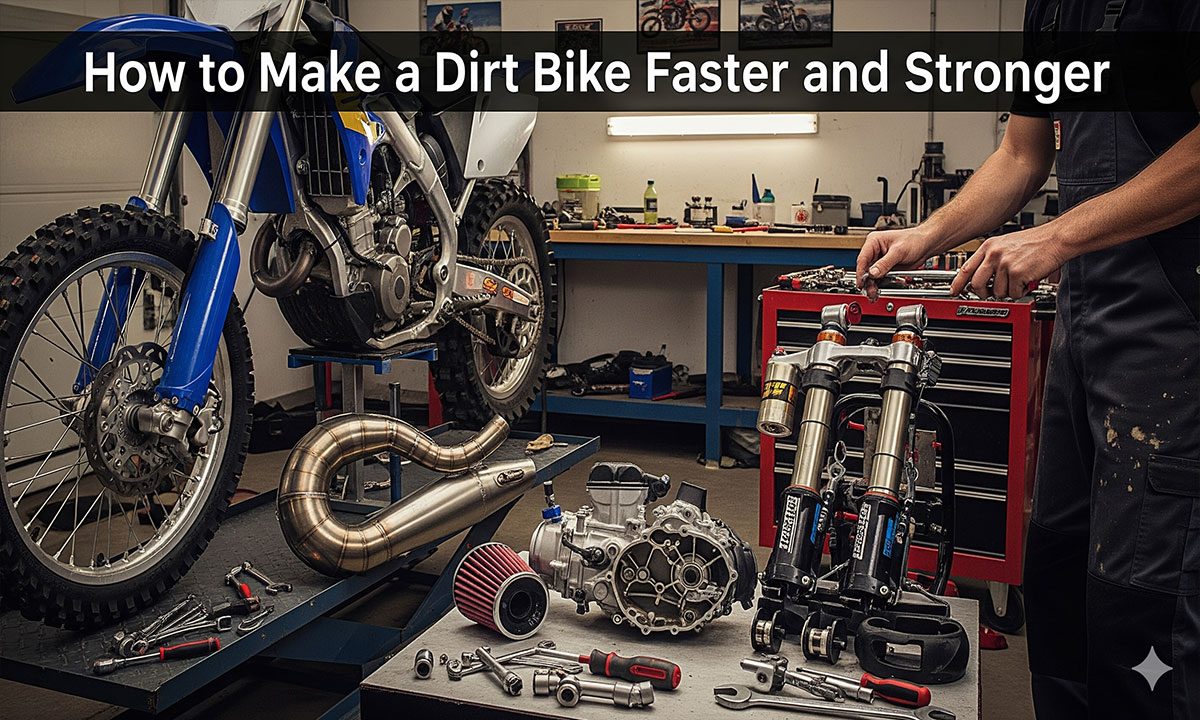

Achieving higher speed and power on your off-road motorcycle is the ultimate goal for many riders. The first step in how to make a dirt bike faster is proper maintenance: keep the engine tuned, oil fresh, and critical parts like the air filter and chain in top shape With solid maintenance, you unlock your bike’s built-in performance potential.
For experienced riders wondering how to make a dirt bike faster, optimizing each component is crucial. This guide dives into key upgrades and tuning tips like Dirt bike engine upgrades, Lightweight dirt bike mods, and selecting the best exhaust for dirt bike speed to give you all the tips needed to boost power, acceleration, and handling.
Engine Upgrades
For many riders, the question of how to make a dirt bike faster starts with the engine. Upgrading engine components is a powerful way to add horsepower.
- Big-Bore Kits & High-Compression Pistons: Installing a big-bore kit increases engine displacement, while high-compression pistons raise the compression ratio Both allow you to burn a stronger air-fuel mixture, yielding more power. These upgrades let your bike burn more fuel-air mixture per cycle, significantly increasing torque and horsepower at the crank For example, a 250cc bike bored to 290cc with a matching piston can see substantial power gains (though it may shorten engine life if not built well).
- Porting and Polishing: Porting the cylinder head (enlarging and reshaping intake/exhaust ports) improves airflow at high RPM and polishing the port surfaces reduces turbulence. These changes let the engine flow air more freely, adding a few horsepower especially at higher speeds. Porting work requires an experienced hand to avoid over-widening ports, which could hurt mid-range power. Polishing out the intake and exhaust ports can yield a few more horsepower at high RPM.
- Performance Camshafts/Reeds: Upgraded camshafts (or flow-optimized reeds on 2-strokes) alter valve timing to favor high-RPM power These parts keep valves open longer or change lift profiles, improving top-end horsepower once properly tuned. Changing cams or reeds shifts your powerband: aftermarket cams often add 2-3 HP at high RPM, but may reduce low-end torque. They should be matched with proper jetting and timing adjustments for smooth performance.
- Clutch and Drivetrain: Upgrading to heavier clutch springs or performance clutch components ensures the engine’s power isn’t lost to slippage This transfers more power to the rear wheel. Also check the chain and sprockets – a heavy-duty chain (e.g. 520 upgrade) and strong sprockets can withstand higher torque. For example, if you install a big-bore kit, also upgrade to a higher-capacity fuel pump and a stronger clutch to handle the extra power. Proper engine tune-up is also crucial: use quality spark plugs, correct jetting or ECU mapping for any mods, and maintain cooling to reliably use your new power. Using higher-octane premium gasoline or race fuel (or an octane booster) allows for more aggressive timing and compression without detonation.
Air Intake and Filters
Allowing the engine to breathe boosts performance. Install a high-flow air filter or intake system to increase airflow Premium filters (often dual-layer) trap more dirt while allowing maximum air into the engine. A clean filter ensures more oxygen for combustion, which significantly improves power. Improving intake flow sets the stage for other mods, since more air means you can burn more fuel to make more power after other upgrades. If you’re heavily modifying the engine, consider also porting or replacing the airbox for even better flow.
Exhaust Upgrades for Speed
One of the most visible ways to make a dirt bike faster is upgrading the exhaust system. Dirt bike riders racing on an off-road track, showcasing speed and performance after upgrades.
A modern exhaust system can significantly affect speed. A slip-on muffler (or silencer) replacement is an easy upgrade: it reduces weight and slightly increases horsepower Full system kits remove more restrictions and can boost peak power, but they often require a tuner kit. Even small weight savings and improved exhaust flow can boost throttle response and acceleration.
- Slip-On Exhausts: These replace only the muffler/silencer. Slip-ons are generally easier to install and lighter than stock, offering a modest horsepower bump at mid-range They improve sound and throttle feel, though significant top-end gains usually require further tuning. Slip-ons often save weight with carbon fiber or aluminum construction, enhancing throttle response.
- Full Exhaust Systems: These replace the header and muffler. A high-performance full system removes many internal flow restrictions, yielding larger peak power gains. Typically, a full system requires a corresponding carburetor re-jet or ECU remap to maximize the increase. Many riders dyno-tune after a full exhaust to safely adjust fuel and ignition.
- Expansion Chambers (2-Stroke): On two-stroke bikes, a tuned expansion chamber dramatically boosts power by using exhaust resonance to scavenge exhaust gas. A well-matched chamber can significantly increase acceleration and top speed in a specific RPM range, effectively making the bike faster in its powerband.
Important: Upgrading the exhaust often affects noise levels. Check local regulations to ensure any new muffler is street-legal if you ride on public trails.
Carburetor and Fuel Tuning
Proper fuel and carb tuning is part of the strategy to make a dirt bike faster. Fine-tuning the fuel mixture is key to maximizing power. A well-adjusted carburetor (or fuel injection map) ensures the engine runs neither too rich nor too lean. Rich mixtures bog down acceleration; lean mixtures can overheat or damage the engine. Re-jetting the carburetor for higher-octane fuel, altitude changes, or airflow mods can yield smoother throttle response and more power. Many riders enlist professional jetting and ECU tuning after adding an exhaust or intake to optimize the air/fuel ratio for maximum power.
Key carb adjustments include:
- Main Jet Adjustment for full-throttle power. A too-small main jet will keep the bike from reaching full RPM; a too-large one may run rich. Adjust in small steps after any exhaust or intake changes Remember: if your bike has carb heaters or a choke, ensure they don’t lean out the mixture inadvertently.
- Pilot Jet Tuning for smooth idle and low throttle response. The pilot jet or idle mixture screw controls fuel at low RPM. Correct pilot settings prevent stalling and improve throttle-off response Make small adjustments and retest each time to avoid running too lean.
- Needle/Jet Needle Position for mid-range power. Raising or lowering the needle clip changes mixture in the mid-throttle range, affecting throttle feel during acceleration. Each clip change can noticeably affect response; using a dyno or reading the spark plug color helps verify the mixture.
- Air-Fuel Mixture: Fine-tune the mixture screw (if present) and keep the airbox sealed. On fuel-injected models, use a fuel controller (Power Commander, etc.) to replicate these adjustments electronically. This ensures that all your engine mods deliver optimum power without blowing up the engine. On fuel-injected bikes, an aftermarket fuel controller or ECU remap can be used to simulate these adjustments and optimize the fuel map.
Gear Ratio Changes
For many riders, thinking about how to make a dirt bike faster includes adjusting the gear ratio. Changing sprockets and gearing is an easy way to tailor acceleration versus top speed. A lower gear ratio (using a larger rear sprocket or smaller front sprocket) gives quicker acceleration at the expense of top-end. Conversely, gearing up with a larger front or smaller rear sprocket will raise your top speed, but the bike will take longer to spin up. As a rough guide, one tooth difference in a sprocket often changes the final drive ratio by a few percent (a couple mph difference on the top speed) Adjust sprockets one tooth at a time and test each change.
- For more top speed, use a larger front sprocket or smaller rear sprocket
- For faster acceleration (better in tight tracks), use a smaller front or larger rear sprocket
Ensure the chain is the proper length after swapping sprockets. Also maintain chain tension: a too-tight chain increases friction, while a too-loose chain can skip and waste power. Keep a spare chain and tools handy when dialing in new gearing.
Lightweight Mods and Weight Reduction
For riders asking how to make a dirt bike faster, shedding weight is one of the most cost-effective strategies. The higher your bike’s power-to-weight ratio, the quicker it will accelerate. Consider lightweight dirt bike mods like carbon-fiber or aluminum parts. Use only high-quality aftermarket parts from reputable brands for critical upgrades; cheaply made parts can break or underperform under stress.
Examples include:
- A Lithium-ion Battery instead of a heavy lead-acid one. This can shave several pounds off the bike.
- Lighter Wheels or Aluminum Sprockets to reduce rotating mass. Lighter wheels improve acceleration noticeably.
- Carbon-Fiber or Titanium Exhaust Components instead of steel. These parts are strong yet much lighter, cutting weight.
- Slimmer Plastics and Accessories: Trim or replace bulky plastics, use minimalist guards or a smaller seat. Even small weight cuts (exhaust, skid plate, footpegs) add up; every pound you remove gives a tangible boost to acceleration.
- Braking Components: Using lighter rotors or calipers reduces unsprung weight. Upgrading to steel-braided brake lines improves brake feel under pressure.
- Seat and Accessories: A minimalist seat or removing non-essential parts (street lights, mirrors) can free up additional weight.
Never remove structural or safety-related parts just to save weight. Every pound shaved effectively acts like free horsepower, improving both straight-line speed and cornering agility.
Chassis and Suspension
Upgrading engine power is only part of the equation – the chassis and suspension must handle it. A properly tuned suspension keeps the tires in contact with the ground, improving traction at higher speeds. For example, firmer fork springs and stronger rear shock springs reduce squat under acceleration and brake dive. Many riders install aftermarket adjustable forks and shocks tuned for their weight and terrain. Properly set sag and damping (adjusted via clickers or tools) can make the bike feel much more responsive and allow you to carry more speed through bumps and turns.
- Suspension Setup: Adjust front and rear suspension to your weight and riding style. Proper sag (about 30% of travel on both ends) and damping settings keep the bike stable at speed. Upgrading to reservoir shocks or adding a steering damper can further improve high-speed stability.
- Wheel and Frame Integrity: Use quality wheels and maintain tight spokes. A strong frame and swingarm prevent flex when cornering or hitting bumps. If available, upgrade to reinforced swingarms, triple clamps, or cross-braces to keep everything rigid under load.
Maintenance and Riding Technique
Never underestimate the fundamentals. Follow the manufacturer’s service schedule: clean or replace air filters, change oil and filter regularly, and keep the chain properly lubricated and adjusted. Using a premium synthetic engine oil helps reduce friction and heat under higher loads. If you’re boosting power significantly, consider adding an oil cooler or upgrading the radiator cap to manage engine temperature. Using higher-octane fuel or race gas (and re-jetting for it) can also increase power.
Check and tighten all fasteners after any ride; performance vibrations can loosen bolts. Also, faster speeds demand better braking. Using high-performance brake pads and a quality brake fluid (DOT 4 or 5.1) helps ensure you can stop quickly. Steel-braided brake lines improve lever feel by preventing hose expansion. Always use proper tools (torque wrenches, thread locker) and high-quality hardware when installing mods – it ensures everything stays put under high loads.
In addition to mechanical tweaks, improve your riding technique: smooth throttle control, good cornering lines, and proper body positioning often yield more effective power delivery than any hardware mod alone. For example, proper tire selection can significantly improve traction and handling, directly affecting speed and performance. Good tires for traction and properly adjusted suspension allow you to put more engine power to the ground. Keep spare parts and tools on hand, and be sure to keep your chain lubricated (a racing chain lube or spray minimizes drivetrain friction) and at the correct slack. A slightly loose chain (at 1 inch slack) prevents excess friction, while a tight chain steals power. Remember that even the fastest bike needs a skilled rider; practice, fitness, and focus can help you achieve faster lap times on the same machine.
Key Tips to Make Your Dirt Bike Faster
- Perform routine maintenance (fresh oil, clean filter) to ensure full power.
- Upgrade intake/exhaust: a high-flow filter and quality slip-on or full exhaust improve airflow.
- Dirt bike engine upgrades: consider higher compression pistons or ported cylinders with tuned camshafts, but tune carefully.
- Lightweight dirt bike mods: use carbon/aluminum parts (wheels, guards, battery) to boost acceleration. Even brake component swaps can help.
- Carburetor tuning for dirt bikes: adjust jets or ECU mapping after any upgrade to optimize fuel mixture.
- Dirt bike gear ratio changes: try a smaller rear or bigger front sprocket for higher top speed, or vice versa for quicker acceleration.
- Upgrade the clutch and drivetrain: stronger clutch springs and a quality chain help transfer new power without slippage
- Use premium fuel and consider an ECU tuner on fuel-injected models to fully utilize mods.
- Test mods one at a time and measure the gains. Keep a log or use a dyno when possible to quantify performance changes.
Frequently Asked Questions
Q: What is the easiest way to make my dirt bike faster?
A: Start with basic maintenance and then consider simple mods. Ensuring clean air filters, fresh oil, and a properly adjusted chain can free up the bike’s original power. Installing a slip-on exhaust or high-flow air filter are relatively easy upgrades that improve throttle response. Even switching to higher-octane fuel and recalibrating your carburetor or ECU can yield noticeable speed gains. In many cases, those two changes alone make a noticeable difference.
Q: Will a new exhaust system significantly increase speed?
A: A quality full exhaust system can raise peak horsepower if combined with proper tuning. A slip-on muffler by itself usually provides only modest gains (mostly by reducing weight). As noted by Brock’s Performance, replacing a stock muffler with a lightweight slip-on mainly reduces weight and can modestly increase horsepower. For the biggest gains, combine a full exhaust upgrade with carburetor or ECU tuning (jetting or a fuel controller) so the engine can take full advantage of the freer-flowing exhaust.
Q: How do gear ratio changes affect performance?
A: Gear ratios trade acceleration for top speed. Using a larger front (or smaller rear) sprocket raises the top speed, making the bike “go faster” on open stretches. Using a smaller front (or larger rear) increases low-end torque and acceleration, ideal for tight, twisty tracks. For example, one tooth on a 13-tooth front sprocket might boost top speed by a few mph. Adjust sprockets based on your terrain—cross-country desert vs. tight motocross tracks—and remember to adjust chain length accordingly.
Q: Is it worth tuning the carburetor after other mods?
A: Absolutely. Any time you alter airflow—through exhaust, intake, or engine mods—you should re-tune the carburetor or fuel injection. A properly tuned carburetor “will improve throttle response, giving you more control and power”. Skipping tuning can negate performance gains or even make the bike run poorly (too lean can cause overheating, too rich can foul the plug). Many riders use a professional dyno tune or carb jet kit to ensure their bike is optimally tuned after hardware changes.
Q: How can I reduce weight for better speed?
A: Replace heavy parts with lighter alternatives, but keep safety in mind. Examples: carbon fiber plastics, aluminum guards, or a smaller Lithium-ion battery can save pounds. Removing non-essential accessories (as long as it’s legal) also helps. Every pound saved improves acceleration; in effect, a lighter bike with the same power is faster. For instance, Brock’s Performance notes that shedding “a few pounds” via a lightweight exhaust can noticeably improve overall performance.
Q: Will making my dirt bike faster affect its reliability?
A: Yes. Increasing engine output and speed often puts extra stress on components. High-performance parts (like pistons, bearings, and clutches) run hotter and wear faster. It’s crucial to upgrade to stronger components (like heavy-duty clutch springs and high-temperature oil) when boosting power. Regular maintenance (oil changes, valve checks, etc.) becomes even more important to prevent failures.
Q: Which single modification gives the biggest speed boost?
A: Typically, improving the engine’s breathing yields the biggest gain: installing a high-flow filter and a well-tuned exhaust (a tuned chamber on a 2-stroke or a full header+silencer on a 4-stroke) often delivers the most noticeable increase. However, it depends on the bike: for example, a small dirt bike might benefit more from engine mods and jetting, whereas a larger bike on a smooth track might see more top speed gains from a slight re-gear.
Q: When should I consider professional tuning or dyno work?
A: After you’ve installed major upgrades (exhaust, intake, engine kits), getting a professional dyno tune or ECU remap is advisable. A dyno session will fine-tune jetting or fuel maps and show actual horsepower gains. This ensures your bike runs safely and performs optimally with the new parts. If a dyno isn’t available, hire an experienced tuner or be prepared for trial-and-error jetting adjustments yourself.
Conclusion
Understanding how to make a dirt bike faster involves a combination of solid maintenance and targeted upgrades. Start with the basics—fresh filters, oil, and chain—to let your bike run at its full stock speed. Then tackle key areas: Dirt bike engine upgrades (like high-compression pistons or ported cylinders), better intake and exhaust systems, careful carburetor tuning for dirt bikes, strategic dirt bike gear ratio changes, and smart lightweight dirt bike mods. Each mod boosts speed by increasing horsepower, reducing weight, or improving throttle response. Remember to tune and test after every change.
By combining these strategies, you’ll feel your bike accelerate harder out of turns and reach higher speeds on the straights. Mastering these upgrades fully answers the question of how to make a dirt bike faster and stronger. Apply mods one at a time, test carefully, and keep your bike tuned. Stay updated with the latest off-road tech in 2025 and beyond; ride with respect for the rules and fellow riders. Remember, all these tips assume you’re wearing proper gear – helmet, boots, and armor are non-negotiable at high speeds. Faster bikes also need better brakes: high-performance pads and good brake fluid help you stop safely. Use premium fuel, consider a fuel controller on EFI bikes, and always check legal requirements for noise and emissions.
Finally, use proper tools (torque wrenches, thread locker) and high-quality hardware when installing mods – it ensures everything stays put under high loads. Apply mods methodically and keep a log or dyno charts to see real gains. Comment below with your own mod experiences – what worked best for you? And if you found this guide helpful, share it with your riding buddies! Stay tuned for more updates as we test new mods on the trail. Ride hard, stay safe, and enjoy the extra speed and power on your dirt bike. Keep the rubber side down and enjoy the ride!
